Enterprise AI conferences and developer AI conferences are designed for different decisions, audiences, and outcomes. However, choosing between them can be surprisingly difficult. The same event may promise practical AI, leading speakers, and networking, yet leave one attendee with a clear next step and another with content that was never meant for their role.
The key difference is usually not the quality of the event. It is the question the event is designed to answer. Enterprise AI conferences vs developer AI conferences serve different audiences, cover different decisions, and create different kinds of value.
Enterprise events are built around how organisations can adopt, govern, scale, and create value from AI. Developer events go deeper on how AI systems are built, evaluated, deployed, and improved. Both matter. The right choice depends on what you need to decide, what you are accountable for, and what you will do differently once you return to work.
Enterprise AI Conferences vs Developer AI Conferences at a Glance
Enterprise AI conferences | Developer AI conferences | |
Primary question | Where should we invest, and how do we create business value from AI? | How do we build, evaluate, deploy, and improve AI systems? |
Typical attendees | CEOs, CIOs, CTOs, CDOs, transformation leaders, business-function leaders, AI and data leaders | Software engineers, ML engineers, data scientists, researchers, architects, product builders, and developer advocates |
Common topics | AI strategy, use-case prioritisation, operating models, adoption, governance, risk, workforce change, ROI, vendor selection | Models, tooling, evaluation, agents, infrastructure, architectures, observability, security, frameworks, implementation patterns |
Best formats | Executive keynotes, enterprise case studies, peer exchange, roundtables, masterclasses, curated networking | Technical talks, workshops, live coding, tutorials, hackathons, product demos, community meetups |
Most useful outcome | Clearer business decisions, peer insight, practical implementation direction, relevant partners | New technical knowledge, implementation ideas, hands-on skills, developer community connections |
Usually the wrong choice when… | You need deep training on a specific framework, model, or engineering problem | You need to align leadership on investment, operating model, governance, or transformation priorities |
What is an Enterprise AI conference?
An enterprise AI conference is designed for people responsible for making AI work inside an organisation. The conversation is less about which framework to use and more about how to decide where AI matters, how to move beyond pilots, and how to embed new capabilities into teams, processes, and decision-making.
That does not mean the content is non-technical. Strong enterprise events still include technical leaders and practical examples. However, the technical discussion is linked to a business decision: whether a use case is worth scaling, how data and governance should support it, what changes in the operating model are required, or which partners can help deliver it.
What You Can Expect to Learn
At an enterprise AI event, the most useful sessions usually answer questions such as:
Which AI use cases are creating measurable value in organisations like ours?
How should we prioritise investments across productivity, growth, customer experience, risk, and operations?
What has to change beyond the technology: data, governance, ways of working, leadership, talent, or incentives?
How can we scale a successful pilot without creating unnecessary risk or fragmentation?
When should we build internally, buy a solution, or work with a partner?
The value often comes from hearing how another organisation handled the difficult parts that do not fit neatly into a technology roadmap. For example, a leader may explain why an AI use case stalled in procurement, how a transformation team gained business ownership, or what they changed after early adoption did not translate into value.
Who should attend an enterprise AI conference?
Enterprise AI conferences are usually the better fit if you influence, own, or are accountable for organisational AI decisions. That includes:
CEOs and general managers setting direction or investment priorities
CIOs, CTOs, CDOs, and CISOs building the foundations for adoption
Heads of AI, data, digital, transformation, strategy, operations, or innovation
Business-function leaders in areas such as marketing, sales, finance, procurement, HR, supply chain, or customer operations
Product and technology leaders who need to align technical delivery with enterprise priorities
They are also valuable for teams that need a shared view. An AI programme rarely succeeds because one person has the right answer. It succeeds when the people responsible for strategy, technology, risk, and the business understand the trade-offs and act together.
What is a developer AI conference?
A developer AI conference is built for people who create and operate AI products and systems. Its centre of gravity is implementation: what works technically, how to use new tools, how to improve performance and reliability, and how to keep up with a rapidly changing ecosystem.
These events can be incredibly valuable, particularly when a team needs hands-on capability. A strong technical conference may include deep dives into model development, agent architectures, retrieval systems, evaluations, inference, security, data pipelines, developer tools, and deployment practices. The best sessions give attendees something concrete they can test, build, or change in their own environment.
What You Can Expect to Learn
Developer-focused events tend to address questions such as:
Which models, tools, and architectures are most suitable for a specific technical problem?
How do we evaluate an AI system for quality, safety, cost, latency, or reliability?
How can we build and deploy agents, retrieval systems, or AI features effectively?
What does a production-ready AI stack look like?
How are other engineering teams handling observability, security, data quality, and iteration?
The networking is also different. Rather than primarily meeting peers facing similar transformation decisions, attendees often exchange implementation knowledge with engineers, researchers, product builders, open-source communities, and developer-tool providers.
Who should attend a developer AI conference?
Developer AI conferences are usually the better fit for:
Software engineers, machine-learning engineers, data scientists, and AI researchers
Technical architects, platform leaders, and MLOps or infrastructure teams
Product builders working directly on AI-enabled products
Developer advocates and technical community teams
Technical founders and early-stage teams whose immediate challenge is product development
They are particularly worthwhile when the team has a defined technical problem to solve, a capability gap to close, or a technology decision that needs deeper understanding.

The Biggest Differences: Strategy, Skills, and the People in the Room
The distinction becomes clearer when you look at what each format is optimised for.
1. The decisions are different
Enterprise AI conferences help leaders decide what to do and how to make it work across the business. Developer AI conferences help technical teams decide how to build it.
For instance, an enterprise leader might need to decide whether customer-service automation should become a priority, who should own it, what governance is required, and how success will be measured. A developer may then need to decide which models, orchestration approach, evaluation process, and deployment architecture can deliver it safely.
Both decisions matter. They simply belong at different points in the journey.
2. The content operates at a different level
Enterprise content typically starts with a business challenge and works towards practical implementation. Developer content often starts with a technical capability or problem and works towards a better solution.
That is why a session on AI agents can feel completely different depending on the event. At an enterprise conference, it may explore where agentic AI creates value, how teams should redesign work, and what governance leaders need. At a developer event, it may examine orchestration patterns, tool use, evaluations, security controls, and production reliability.
3. The networking has a different purpose
At an enterprise event, the most valuable conversation may be with a peer from another industry who has already addressed a similar transformation challenge. It may also be with a provider or expert who can help turn a strategic priority into a practical programme.
At a developer event, the most valuable conversation may be with an engineer who has solved a similar implementation issue, an open-source maintainer, or a technical product team building on the same stack.
Neither is inherently better. The question is which conversation will help you make progress now.
4. The return on time looks different
The return from an enterprise event is often a stronger decision, a more useful peer relationship, a clearer business case, or a better understanding of the risks and operating changes involved in scaling AI.
The return from a developer event is often a new skill, an implementation shortcut, a stronger technical network, or a concrete approach the team can trial immediately.
If you are attending on behalf of a company, define the expected outcome before you book. “Learn about AI” is too broad. A better outcome might be: validate our AI operating-model approach; identify three relevant use cases; decide how to evaluate vendors; or improve our team’s approach to production evaluation.
How to Choose the Right AI Conference for Your Role
Start with the decision you need to make in the next six to twelve months.
Choose an enterprise AI conference if you need to:
Turn AI ambition into a prioritised business plan
Learn from organisations that have moved beyond isolated pilots
Align leaders across business, technology, data, risk, and transformation
Understand governance, operating-model, and adoption challenges
Meet enterprise peers and relevant AI solution providers
Build a stronger case for investment or executive approval
Choose a developer AI conference if you need to:
Build practical technical capability in your team
Make an architecture, model, tooling, or framework decision
Solve a defined engineering or deployment problem
Learn through workshops, tutorials, live demos, or code-level examples
Connect with technical communities, researchers, and product builders
If you need both, do not force one event to do the job of two. Send the right people to the right format, then bring the learning together. A technology team may attend a developer event to deepen implementation capability, while business and transformation leaders attend an enterprise event to align the organisation around where and how AI should create value.
When an Enterprise AI Conference is the Better Choice
An enterprise event is the stronger choice when the hardest part of your AI programme is no longer access to technology. It is making the right organisational decisions.
That is common for established companies. They may already have access to models, tools, cloud platforms, and talented teams. What they need is clarity on priorities, ownership, governance, adoption, and value creation. In those situations, a conference full of code examples may be interesting but not sufficient.
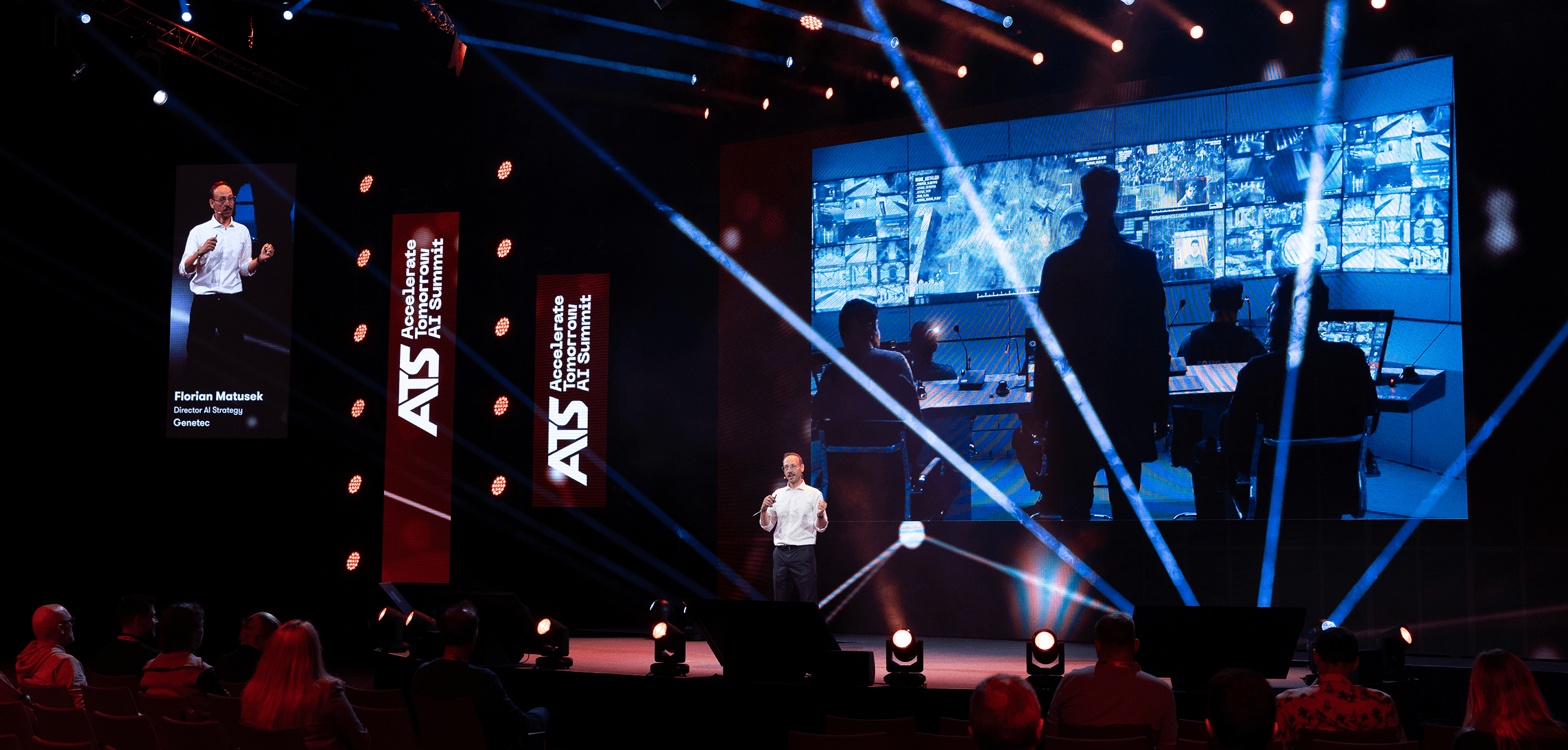
Accelerate Tomorrow AI Summit (ATS) is built for this stage. Taking place on 15-16 June 2027 at Estrel Berlin, ATS brings together 2,000+ business and AI leaders to examine how companies turn AI into business value. The focus is on real transformation questions: which use cases to prioritise, how to move beyond pilots, how teams and operating models need to change, and what responsible adoption looks like in practice.
ATS combines enterprise case studies, executive perspectives, practical masterclasses, peer exchange, and an AI Partner Space. It is not intended to replace hands-on developer training. Instead, it gives leaders and cross-functional teams the context, examples, and relationships needed to make better enterprise AI decisions.
When a Developer AI Conference is the Better Choice
Choose a developer-focused event when your immediate bottleneck is technical execution. Perhaps your team is deciding how to evaluate an agent, improve a retrieval system, select a model, manage inference costs, or build secure deployment processes. In that case, a technical programme with workshops and practitioner deep dives will often create more immediate value than a general executive agenda.
This is not a reason to ignore the business context. It is a reason to give technical teams the specialist environment they need. The strongest organisations combine both perspectives: leaders create the direction and conditions for adoption, while technical teams build reliable systems that deliver on that direction.
The Right Choice is the Event that Helps You Act
The best conference is not necessarily the biggest, the most technical, or the one with the most familiar names. It is the one that helps you take the next useful step.
Choose an enterprise AI conference when you need to make better decisions about AI across the organisation. Choose a developer AI conference when your priority is building, improving, or operating the technology itself. When both are important, make the distinction explicit and send the people responsible for each decision to the format that will help them most.
Frequently Asked Questions
Are enterprise AI conferences useful for technical leaders?
Yes. CIOs, CTOs, CDOs, technical architects, and Heads of AI often benefit from enterprise events when they need to align technology decisions with business priorities, governance, adoption, and organisational change. However, they should choose a developer conference instead when their main goal is deep technical training or solving a defined implementation problem.
Are developer AI conferences only for engineers?
No. Product leaders, technical founders, and AI programme leaders can also benefit, especially when they need to understand the practical constraints of building and operating AI systems. However, non-technical business leaders will usually gain more from an enterprise event focused on strategy, implementation, and transformation.
Should a company send different people to different AI conferences?
Often, yes. The best approach is to match the attendee to the expected outcome. Business and transformation leaders may attend an enterprise AI conference to learn from peers and make better strategic decisions, while engineering and data teams attend developer events to build the technical capability required to deliver those decisions.
Can one AI conference cover both enterprise strategy and developer skills?
Some events include both business and technical tracks, and that can be useful for a mixed team. However, breadth is not the same as depth. If the organisation needs executive alignment and hands-on technical capability, separate events or a deliberately planned combination will usually deliver more value.